
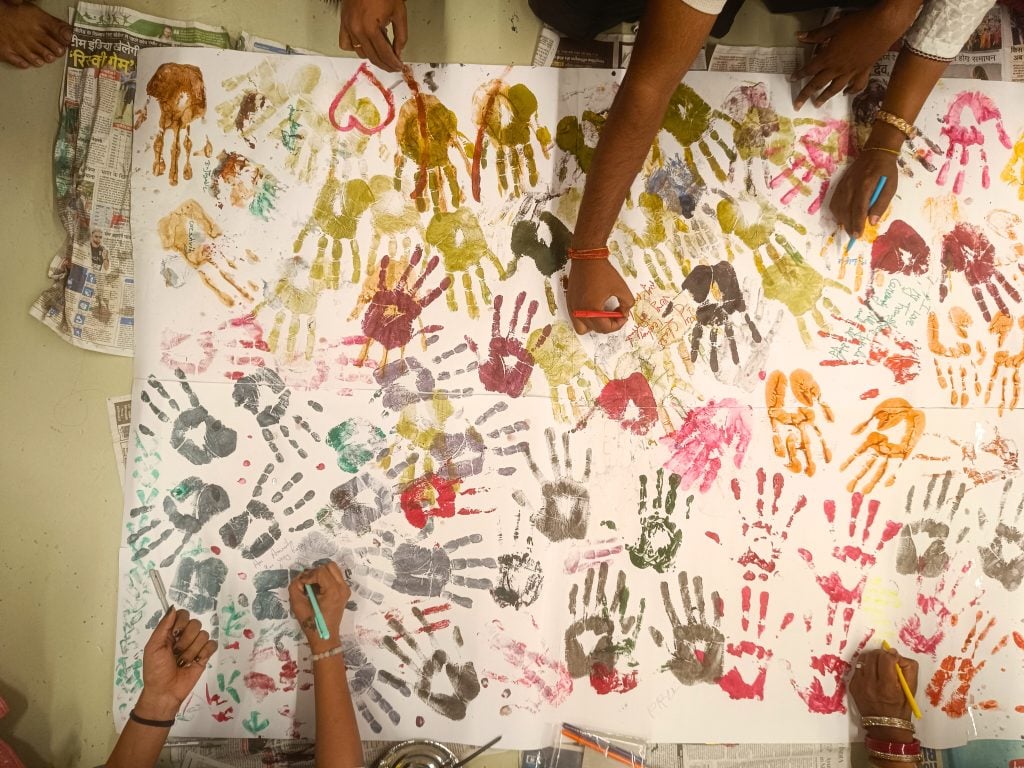
“Healing takes courage, and we all have courage, even if we have to dig a little to find it.”– Tori Amos
When we began conceptualising the Survivor Liberation Program at One Future Collective, we discussed multiple possibilities for a healing and livelihood program, rooted in our aspirations, ambitions, and years of experience working with survivors. We wanted the program design to be responsive to the needs of survivors of sexual and gender-based violence and, at the same time, consider the long-term, non-linear healing needs. We eventually decided to run it as a two-layer healing and livelihood program, where our primary focus would be on building survivor-led healing spaces, while complementing the livelihood efforts of organisations already working in this area.
Our design asked a simple but radical question: What would care and healing look like, in ways that strengthen survivors’ autonomy, community, and follow their lead? This program has been a testament to the success of a survivor-led model, which puts the survivors at the centre of their own healing and recovery journey. This blog is an attempt to name some of the team’s learnings and reflect on the kinds of impact that feel most meaningful – particularly when we centre survivors as leaders of their own healing.
About the Program
From October 2024 to April 2025, we walked alongside women, queer, and trans survivors of sexual and gender-based violence to create a space where both healing and livelihood could flourish together. At its heart, this program is built on a simple truth: survivors should never have to choose between survival and safety.
Over the course of six transformative months, we conducted 10-session psychosocial well-being programs, led by five women and queer mental health professionals (Mihika, Radhika, Aritra, Mansi and Yashtika) trained by One Future Collective. This program complemented the efforts of five partner organisations (Each One Feed One, Naz Foundation, Bengal Transmen Collective, Shakti Shalini and CORO India), which were running livelihood initiatives across Delhi, Mumbai, and Kolkata.
Reimagining Survivor-Led Ecosystems
One of the earliest and most important design choices we made was to move away from a purely service-delivery model. Traditional models often position organisations as the primary holders of expertise and survivors as recipients of care. While access to mental health support remains crucial, we recognised that approaches that do not view survivors as co-shapers of their own journey can unintentionally reproduce hierarchies and long-term dependence, particularly in a context where civic spaces are shrinking and organisational continuity is uncertain.
Instead, we chose to invest in a community-led approach. Survivors were not only participants but co-shapers of the program’s direction, rhythm, and content. This meant holding looser structures, making space for emergence, and sometimes sitting with ambiguity. It also meant trusting that survivors already hold deep knowledge about what they need, even when that knowledge is difficult to articulate.
This has been an exercise in adopting a different kind of rigour, one that is rooted in listening, responsiveness and accountability to the collective rather than adhering to a fixed blueprint.
Healing Is Relational, Not Linear
We know that healing is not linear, that is, it does not follow a neat, upward trajectory. Survivors’ lives may be shaped by ongoing structural violence, such as economic precarity, caste and class oppression, transphobia, ableism, and more. To expect consistent “progress” within such realities is rather unfair. Thus, we designed the program as a cyclical process, with multiple opportunities to return to grounding, somatic practices, collective reflection, and meaning-making. Some weeks were heavy, some light, some quiet – attendance fluctuated, energies fluctuated – but everyone did show up, as best as they could be.
This redefined consistency for us as sustained relational presence. Survivors kept returning, even after gaps, and they remembered the session rituals and each other’s stories. These were signs of something steady taking root.
Transformation does not always have to be flashy
Transformation does not always have to be loud – change is not always visible, but it is often felt. We began noticing impact in small, ordinary practices:
- Establishing opening and closing rituals
- Gently revisiting collective agreements
- Pausing when someone feels overwhelmed
- Being flexible with session plans based on the energy in the room
We have firsthand witnessed how these seemingly ordinary practices accumulate over time and create a sense of safety. We also saw that survivors were using some of the rituals outside of the sessions, as grounding exercises and self-soothing practices in their daily lives.
Redefining Impact
Traditionally, we have defined impact in terms of numbers, participants, outputs and sessions delivered. However, this program has shifted this deeply for us. These experiences pushed us to expand how we understand impact.
Impact can also look like:
- A survivor saying, “I never even thought that we could touch ourselves with our own hands.”
- A participant cooking one of their cultural dishes for their facilitator
- The facilitators and participants eating together
- Witnessing someone gradually open up from the first session to the last
- A collective framing “Hum saath aate hai, hum alag hote hai, hum aage badhte hai”
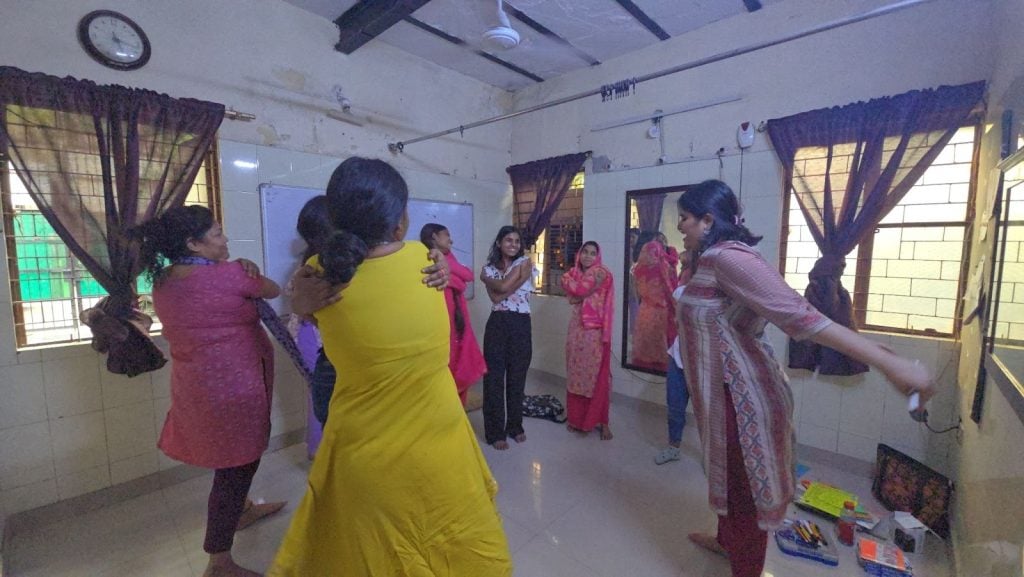
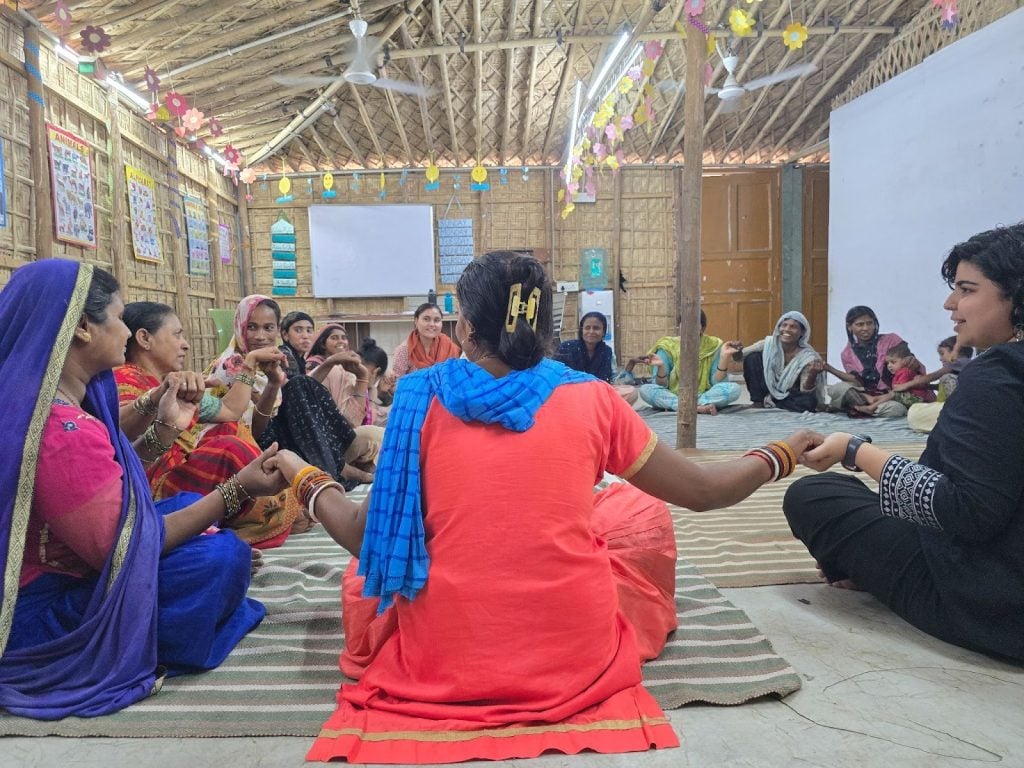
Image 1 & 2: Participants, along with the facilitator, as they begin and close the session
These may not be easily quantifiable. But they are profound.
At an organisational level, it has strengthened our commitment to survivor-led models and has sparked internal conversations about how we design for sustainability in uncertain contexts, while keeping both the survivors and those working to support survivors at the centre of the program design.
What’s next for us?
The Survivor Liberation Program has concluded; however, it is a living thread of our work. There are many things we are still grappling with: accessibility across languages, deeper inclusion of disabled survivors, long-term pathways for survivor healing, and sustainable resourcing.
What we feel most certain about is that survivors do not only need to be passive recipients of services. They need communities, dignity, and spaces that recognise them as agents of their own healing journey.
This program has taught us that transformation rarely announces itself. It often looks like people sitting in a circle, breathing together, telling their truths, and choosing – again and again – to show up for themselves and each other. Sometimes transformation is simply: I am still here.
And sometimes, that is more than enough.
To know more about this project, you can watch a short video here and read about the program here.