

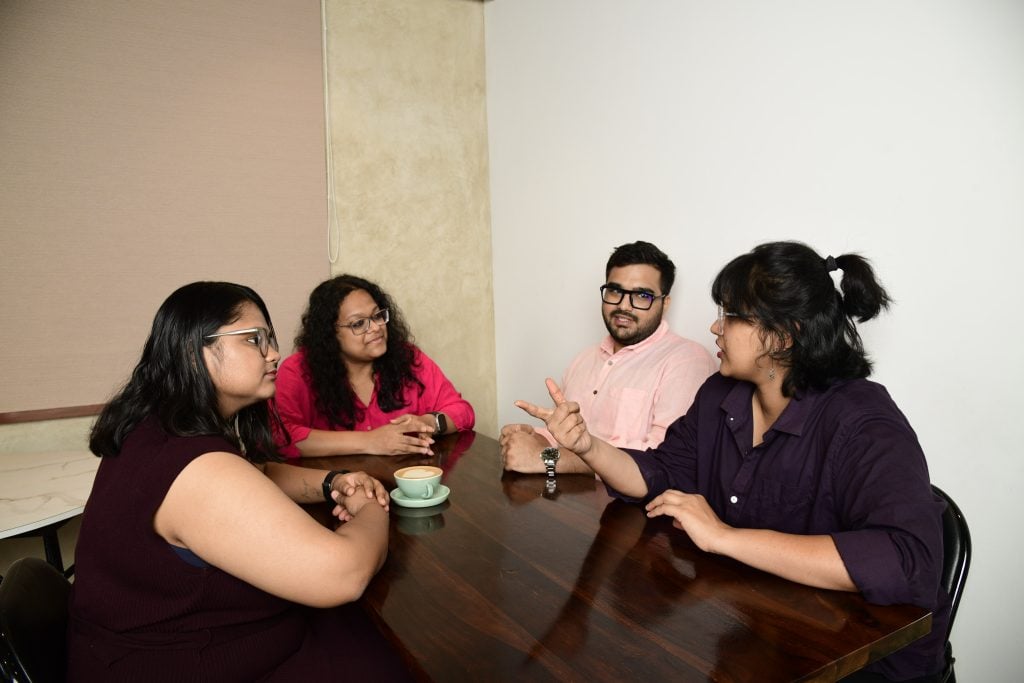
We kicked off a new conversation series #NoRightAnswers, hosted by Vandita Morarka (Founder & CEO, One Future Collective), at the Feminist Leadership Hub in March 2025. #NoRightAnswers is a conversation series for feminists to come together and hold space for the questions that don’t have easy answers, especially those that are cyclically stuck or often avoided in feminist work.
The first conversation of the series was ‘Youth Leadership’, with 5 participants of varied age groups and geographic locations. This series invites us to sit with the complexity of some of the questions and challenges we face as we navigate the world, and our first conversation did exactly that: some participants shared their experiences of facing negative judgements for being too ‘young’ and inexperienced, while another questioned whose expertise is valued. We unpacked some key themes, such as our understanding of ‘being young’, ageing anxiety and the differences in experiences of chronological age, particularly for queer and disabled folks.
Do we all have the same relationship with ageing?
Our relationship with ageing is often shaped by our cultural context, gender, caste, race and other social identities. Societal norms set an expectation of a linear ageing process with pre-defined milestones in your 20s, 30s, 40s and so on. However, ageing is not a linear process.
“We all grow up in different timelines.” – A Participant
For someone with limited financial access and stability, a sense of financial maturity may have settled in their late teens or early twenties, or they may have had to start earning earlier than their peers, leading to feelings of “growing up too early”. For someone with disability, their experience of ageing can differ drastically from an able-bodied person. For a queer person to be fully experiencing their lives as their true self may not necessarily follow the same timeline as their chronological age.
Similarly, some people may have achieved a sense of financial stability only in their early 30s or 40s, or after they moved to a different city or had the resources to pursue a course, which then allows them to explore opportunities that they may not have had access to in the past. One of the participants identified themselves as a “late bloomer” and shared their experience of moving to a new country where their expertise was not as valued and they were consistently assessed against colonial ideas of ‘professional expertise’.
These themes also paved the way for the articulation of the ‘ageing anxiety’. Many shared increasing concerns around ageing and the exclusion from certain opportunities, fellowships, learning programs and so on, due to the age criteria and the high focus on young people. If our social identities influence our ageing and shape our access to resources to avail opportunities, how might we then redefine the age criteria for fellowships, programs, grants and so on?
Ageing is also gendered. An example from the entertainment industry was highlighted by one of the participants, where male and female actors’ career progression looks different with male actors getting sustained, adequate (if not more) opportunities in the industry as compared to their female counterparts and the kinds of role that actors are expected to do as they get older is also defined by their gender. The participants also shared similar experiences where they have been assessed differently based on how they present themselves as a young person.
Oftentimes, we envision a young person as full of energy, open to learning and working at a lower salary and an ‘easy-going’ attitude. These expectations are further compounded by gender. Women struggle to be taken seriously if they do not present themselves in a certain way that conveys ‘seriousness’. Particularly in the context of queer and disabled folks, how they show up influences how respected they are in a space and the value placed on their expertise and leadership.
Are we investing in young people or ‘youth’?
In the last few years, we have seen an intentional shift of resources, attention and investment towards youth leadership. There have been targeted initiatives to build their capacity and leadership; however, there are limited safety nets available for them, and there is not enough focus on what young people may need to continue their leadership journey in the present times and as they grow older.
Public media like social media and other online tools have been leveraged by young people for activism and hold systems accountable in a way that the systems are not used to. The meme content and jokes around the differences in how different generations, particularly Gen Z, Millennials and Gen Alpha, approach work are reflective of the perceived differences across generations. While the tech tools have created space for activism in ways that was perhaps not possible two decades ago, what is often missing in these conversations is the risk of burnout for young people in the face of restricted social protections, financial and health safety nets.
The capitalist structures have continued to make gains at the expense of the ‘energy’ of young people. It is considered cheaper to hire and discard young people cyclically, as it reduces the cost of providing maternity, childcare and other carework-related benefits or accommodations. While older people may bring more experience, young people are seen as a homogenous group with a high appetite for risk, high energy and not in need of any kind of accommodations.
However, investing in youth leadership not just demands high willingness or a strategic shift but also intentional investment of resources; however, this underlying cost often remains invisible. Additionally, we need to start focusing and preparing for a cyclic transition for each generation and not see people, as they age, as ‘disposable’.
This calls for reimagining youth, ageing and leadership. We cannot be perpetuating the same structures that we seek to dismantle. We must challenge our understanding of expertise, lived experiences and age to break free from the binary understandings of young-old. We need to focus on creating and facilitating intergenerational spaces and explore possibilities of collaborative co-existence rather than competition.
“Last thing I want to do is compete with someone younger because I’ve been that person and I want them to get opportunities too – this can’t become a zero-sum game.” – Vandita Morarka
This engaging, insightful conversation wrapped up with more questions than answers (as intended to be!).
- How do we build movements that put youth leadership at the forefront?
- What do all of us need to feel more equipped in our journey, regardless of our chronological age?
- How do we navigate some of the intergenerational tensions within the movement-building work?
- How might we create spaces for both young and old leadership?
- Ten years from now, what kind of roles do we imagine young people of today playing in the movement?
If you find yourself navigating such complex and layered questions, do join us for our next conversation. You can join the Feminist Leadership Hub by clicking here to receive regular updates on the upcoming conversations in this series.