

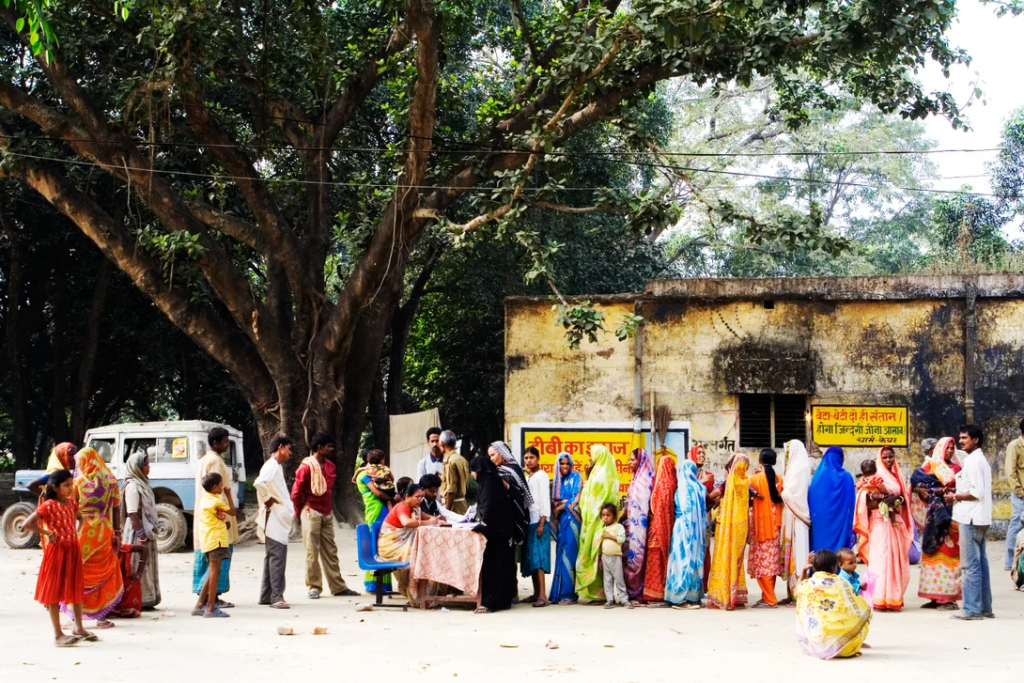
‘outside a primary health care centre in Bihar, patients queuing up to receive a token from the attendant’
Source: Refinery.29, Courtesy: Siddharth Jain/Action Aid Bihar
Envisioning Health for All in a Budding Nation
At the cusp of Independence, India’s imagination of its healthcare system was shaped by the landmark Bhore Committee Report (1946).1 The committee articulated a vision for a nascent nation in which the health of its citizens was of utmost importance, for they were the agents through whom the ideals of democracy and development would be realised. This foundational articulation treated health not as a privilege or a market exchange, but as a state responsibility where the public did not have to seek healthcare, but healthcare was brought to their doors when they needed it most. This foundational vision is quite divergent from how healthcare is envisioned in India today.
Preventive care was central to the foundational vision. In this conception, prevention was not framed as individualised consumption or lifestyle optimisation. Today, preventive health is often imagined through private gyms, supplements, diagnostics, and wellness products, largely accessible to a narrow, urban, upper-class, upper-caste, and dominant gender demographic. In contrast, the Bhore Committee envisioned prevention as collective and structural. It included matters of housing, sanitation, nutrition, clean water, and accessible primary healthcare, anticipating what we now understand as the social determinants of health. Preventive and curative care were not envisioned as siloed. They were imagined as part of a continuum, delivered through a tiered public health system. This vision materialised through Primary Health Centres (PHCs) and sub-centres (SCs), designed as spaces where early intervention, community engagement, and treatment could converge. Even today, despite years of neglect and underfunding2, these institutions continue to form the backbone of India’s public healthcare system.
The Political Economy Shift: From Public Health to Market Intervention
Despite the clarity of this early public health vision, the trajectory of India’s healthcare system was weakened by underfunding, uneven implementation, and growing inequities in access and quality. However, healthcare was still, with all its shortcomings, the responsibility of the state. As India gradually moved away from state-led planning and toward market-oriented reforms, particularly under the global influence of neoliberal economic policies, healthcare increasingly came to be organised as an economic sector rather than a social care entity.
Privatisation, understood as the transfer of public responsibilities, financing, or service delivery to private actors3, has fundamentally reshaped Indian healthcare. Hospitals, diagnostics, pharmaceuticals, and insurance are now deeply embedded in market logics. In corporate healthcare settings, doctors are frequently evaluated not by health outcomes or continuity of care, but by revenue generation. Treatment plans, time spent with patients, and even diagnostic decisions are increasingly shaped by profitability.4
As a result, care itself becomes conditional and fluid. It is made available primarily to those who can afford to participate in this ecosystem of profitability, while those who cannot are pushed to the margins or excluded altogether.
This shift has measurable consequences. Studies point to a clear relationship between rising inpatient costs in the private sector and declining utilisation of healthcare services among lower-income communities.5 For many families, even a single hospitalisation at a privatised hospital can lead to health expenditure that exhausts monthly incomes, forces the sale of assets, and wipes out savings accumulated over years. Faced with these risks, people delay care, discontinue treatment, or avoid seeking medical attention entirely.
Accessing Care under a Private Equity Umbrella: Examining the Case of All India Institute of Medical Sciences, Delhi
All India Institute of Medical Sciences (AIIMS), Delhi, a public tertiary hospital and medical school, sees an annual influx of more than 2 million outdoor patients. However, ironic to its paramount status, as of August 2025, 35% of doctor positions remain vacant. While the exact reasons are not officially noted, public discourse tilts towards the highly competitive packages offered by corporate hospitals with foreign equity that are enticing to medical professionals, as opposed to an institute that has also been reporting a lack of infrastructure facilities required.6
Substantiating this claim, Sanjeev Kelkar, in their work ‘India’s Public Health Care Delivery’, breaks the myth of doctor shortages as a reason for the lack of care and points to the skewed representation of doctors in cities compared to rural areas. While AIIMS is here in the metropolis, the migration of doctors from state healthcare ecosystems to private ones follows a similar logic – one that points to an overpowering healthcare marketplace that considers patients not merely as rightful receivers of care but also another weight on the balance scale that tilts the results towards higher equity gains. The damaging consequences of this state of healthcare result in some of the most inhumane conditions. For instance, in a devastating sight, patients travelling from neighbouring states, UP and Bihar, have been waiting for their appointments. Given the distance they have to travel to reach Delhi, and the lack of resources to stay in a city as costly, they are forced to camp outside the hospital in overcrowded groups, bearing the brunt of Delhi’s unforgiving winters. 7
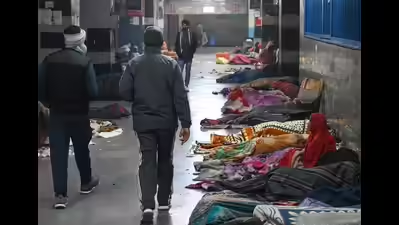
Patients sleeping in a subway outside AIIMS, Delhi, in freezing temperatures
Source: Times of India
The All India Institute of Medical Sciences was established following a recommendation in the Report of the Health Survey and Development Committee, i.e., the same Bhore Committee Report.
Institutional decline, however, is only one dimension of the access problem. Further examining the case of AIIMS Delhi, it must be noted that women are underrepresented as patients, with research pointing to over 4 Lakhs women missing from how many there ought to be, as per analysis. Even among the women who make their way to avail treatment here, there is an underrepresentation of older and younger women.8 Zooming out from the context of AIIMS Delhi for a moment, the question of accessing healthcare becomes even more complicated when marginalities intersect, compounding their effects and pushing one further away from tertiary private healthcare.
These patterns cannot be explained through single-axis analyses of gender or income alone. Intersectionality helps us understand how caste, gender, disability, sexuality, and class interact to produce compounded exclusion. A Dalit woman with a disability, for instance, does not experience barriers in addition. She encounters a healthcare system structured to exclude her precisely because of how these identities intersect.
Women belonging to Dalit-Adivasi-Bahujan communities end up relying the most on public healthcare compared to Savarna women. For instance, SC women utilise public health facilities for institutional deliveries at the highest rate (61.3%), followed by ST (53.6%) and OBC (53.5%). In contrast, women from ‘Other’ castes utilise public facilities for deliveries the least (51.3%), preferring non-public options. Upon further probing to understand the cause of the lack of access to private facilities beyond monetary reasons, research indicates that approximately 46.7% of SC households and 47.1% of ST households cited ‘no nearby facility’ as a major barrier.
This spatial absence is not accidental but rooted in caste-based settlement patterns. Anti-caste literature has long documented how marginalised castes, specifically Dalit communities, have been forced to live on the periphery of a village – a pattern that also finds itself replicated in urban spatiality.9 Therefore, it must be noted that the question of accessing care is not merely a matter of geographical accessibility, but also of the underlying social systems that dictate it and how they’re interconnected.
For many marginalised communities, access is also shaped by past experiences of humiliation, neglect, or outright violence within medical institutions. For trans persons and individuals from queer communities accessing healthcare, there is also a dearth of substantive data to document their experience with the shifting dynamics from state-sponsored to privatised healthcare. For them, fear of discrimination, dismissal of pain, or moral judgment becomes a deterrent in itself.10 Healthcare, in such contexts, is not experienced as a right, but as a space that must be navigated carefully, if at all.
The Persistent Overpowering of Private Healthcare
Despite these realities, private healthcare remains widely perceived as superior. If given a choice, many people aspire to seek treatment in private hospitals. This preference is not irrational. It is shaped by visible markers of quality, including shorter waiting times, cleaner facilities, advanced equipment, and the perception of specialised expertise.
The Bhore Committee had emphasised that comprehensive healthcare requires collaboration between the public, healthcare providers, and medical professionals. Under a market-driven system, however, an additional and dominant actor enters the equation: the private corporation. Here, the patient is reconstituted as a consumer, and illness itself becomes a source of profit. In such a framework, equitable collaboration in the public interest becomes structurally difficult, if not impossible.
These market logics are no longer limited to private actors alone. They are now deeply embedded within state policy. Instead of strengthening preventive and community-based public healthcare that accounts for how caste, gender, disability, and sexuality shape health outcomes, the Indian health system increasingly prioritises curative interventions delivered through private infrastructure. Ayushman Bharat – Pradhan Mantri Jan Arogya Yojana is often cited as a flagship pro-poor health intervention; the program seeks to expand insurance coverage for the underserved, wherein beneficiaries of the scheme can receive treatment from an empanelled private facility without out-of-pocket expenses, leading to public funds being channelled into private facilities, while public health institutions remain chronically underfunded. 11This model effectively subsidises private healthcare expansion without addressing the systemic neglect of public healthcare delivery. It must be noted, however, that the scheme has also witnessed a mass exodus of private hospitals from the empanelled list due to failure of interest rate revisions, delays in payment, etc. – increasing pressure on an already crumbling public infrastructure.12
However, at the same time, the labour that sustains the state healthcare system, ensuring that services reach the last person on the ground, is itself deeply stratified. This devaluation of care labour reflects the same market logic that prioritises capital-intensive private care over sustained public investment. For example, the Accredited Social Health Activists (ASHA) workers form the backbone of India’s community health infrastructure. They are responsible for maternal health, immunisation, disease surveillance, and health education. Yet they are officially classified as volunteers, denied minimum wages, job security, and social protection, and continue to receive ‘honorariums’ instead of statutory wages. This feminised and caste-marked labour is systematically devalued, even as it is essential to public health functioning. As of this date, ASHA workers continue to fight for recognition as healthcare workers.13
Therefore, the rapid expansion of the private healthcare sector, coupled with sustained state support for a privatised ecosystem and the simultaneous undercutting of public systems that act as agents of the state, has produced a monopolistic tendency. This has increasingly compelled people to rely on private healthcare when seeking what is perceived as quality care. India has historically had a pluralistic healthcare ecosystem – with forms of medicine such as unani, expertise of the dai (midwife) as a care provider, etc. However, within a monopolistic ecosystem, large hospital chains consolidate power alongside dominant practices of the dominant majority (such as Ayurveda), while smaller providers and alternative systems of care are marginalised.14 As a result, India’s historically plural healthcare landscape, which included indigenous, community-based, and preventive practices, has steadily narrowed in favour of a centralised, allopathic, privatised, curative, and hospital-centric model.
When Privatisation and Polycrisis Converge
The COVID-19 pandemic of 2020 exposed a harsh, pre-existing reality of India’s fragmented healthcare ecosystem: a system pushed to the brink by shortages of doctors, inadequate infrastructure, and rising medical costs.1516 This crisis was not an aberration but the result of decades of policy choices. A lesson learnt from it was how, in a time marked by overlapping crises, the question is no longer just how care will be delivered, but whether health can once again be understood as a shared public responsibility.
In the years since COVID-19, climate change has emerged as the next such component of polycrisis that the world is facing, one that is bound to intersect once again with the realities of a fragmented healthcare system. Rising temperatures, erratic rainfall, extreme weather events, air pollution, and the spread of vector-borne diseases are no longer future projections. These are lived and measurable realities.
Climate impacts are filtered through existing structures of inequality. As noted earlier, Dalit-Bahujan-Adivasi communities are forced to live in the periphery of habitations. Topographically, these are also environmentally vulnerable regions, including flood-prone areas, water-scarce zones, and areas affected by industrial pollution, making these communities further at risk of experiencing the ills of climate change.17
Women bear a greater burden of care work during climate crises. Persons with disabilities face heightened risks during evacuations and disasters due to inaccessible infrastructure. Queer persons, particularly those without family support or stable housing, often lack the resources needed to withstand climate shocks.
As disease burdens rise and displacement becomes more frequent, the need for accessible healthcare grows precisely when healthcare systems are becoming increasingly commodified through privatised models of care. This is the compounding crisis confronting India today. Climate change is intensifying health vulnerabilities while healthcare is becoming more commodified. The communities most affected by climate-related health risks are also those least able to navigate profit-driven healthcare systems. For instance, by the end of 2025 and the beginning of 2026, across major metropolises in India, including Mumbai, Bengaluru, Hyderabad, and Kolkata, the Air Quality Index rose to hazardous levels, with the AQI near the National Capital Region (NCR) rising to above 1000. Research notes how even here, it is the most marginalised populations who are trapped in the most affected.18
This convergence is not accidental; it reflects structural injustice. A healthcare system organised around profit, added onto historical inequalities of caste, patriarchy, and ableism, produces predictable and deeply unequal outcomes.
Reclaiming Healthcare as a Right
A feminist and intersectional approach to health justice demands that policy begin with those most marginalised, not treat them as an afterthought. India requires robust, well-funded public health systems grounded in an understanding of social determinants of health. Gender Equality, Disability, and Social Inclusion (GEDSI) standards that actively identify structural barriers and power hierarchies, focusing on gender equity, disability justice, and broader social inclusion, must be meaningfully integrated into health planning and implementation. Community-based and indigenous health practices must be recognised, resourced, and respected as part of a plural healthcare ecosystem. Care workers, particularly ASHA workers and other such community workers, must receive fair wages, job security, and recognition as skilled healthcare professionals. Climate-resilient health systems must explicitly account for how caste, class, patriarchy, and ableism shape vulnerability.
Healthcare is a right, not a commodity. Reclaiming it as such is essential, not only for health equity but for social justice itself.
About The Author
Manasa (she/her) is a feminist researcher with interests spanning gender, disability justice, labour, media systems and culture. As a Manager at One Future Collective, she works on various social impact consulting projects spanning gender and policy audits, organisational strategy and visioning, as well as conducting participatory research for advocacy projects. Outside work, you’ll find them on history walks, exploring the streets of Mumbai, and (diligently) queued up for first-day-first-show screenings at single-screen theatres.
- Report of the Health Survey and Development Committee Survey ↩︎
- Poor healthcare at grass root level across India: NHRC asks Union Health Secretary to reply
↩︎ - Privatisation Laws
↩︎ - Revenue targets, management staff making doctors pawns in corporate hospitatop-rankedls: Study
↩︎ - Health care utilization and expenditure inequities in India: Benefit incidence an,lysis
↩︎ - Doctor exodus & faculty vacancies cripple India’s AIIMS system. What’s causing the crisis
↩︎ - For AIIMS patients and kin, subways become night shelters
↩︎ - India’s women may be missing tertiary healthcare
↩︎ - Urban Dalit identity and caste in Ahmedabad: Ambedkar’s vision and its reality
↩︎ - Understanding discrimination against LGBTQIA+ patients in Indian ,ospitals using a human rights perspective: an exploratory qualitative studOonanton
↩︎ - Universal Health Care System in India: An In-Depth Examination of the Ayushman Bharat Initiative
↩︎ - Ayushman Bharat PMJAY: A health scheme that needs healing
↩︎ - ASHAs protest against Union Budget
↩︎ - Achuthan, A. (2024). The Dai and the Indigenous: Notes on the Appearance and Disappearance of a Figure in the Therapeutics of a Nation. Taylor & Francis.
↩︎ - High inflation and Covid-19 are forcing the poor in India to dip deeper into their savings
↩︎ - India’s Frantic Fight Against COVID-19: Rescuing a Broken Healthcare System by Adopting a “Doctor and Patient First” Approach
↩︎ - Vulnerable and Marginalised at Receiving End of Climate Change
↩︎ - Air Quality and Environmental Injustice in India: Connecting Particulate Pollution to Social Disadvantages
↩︎