

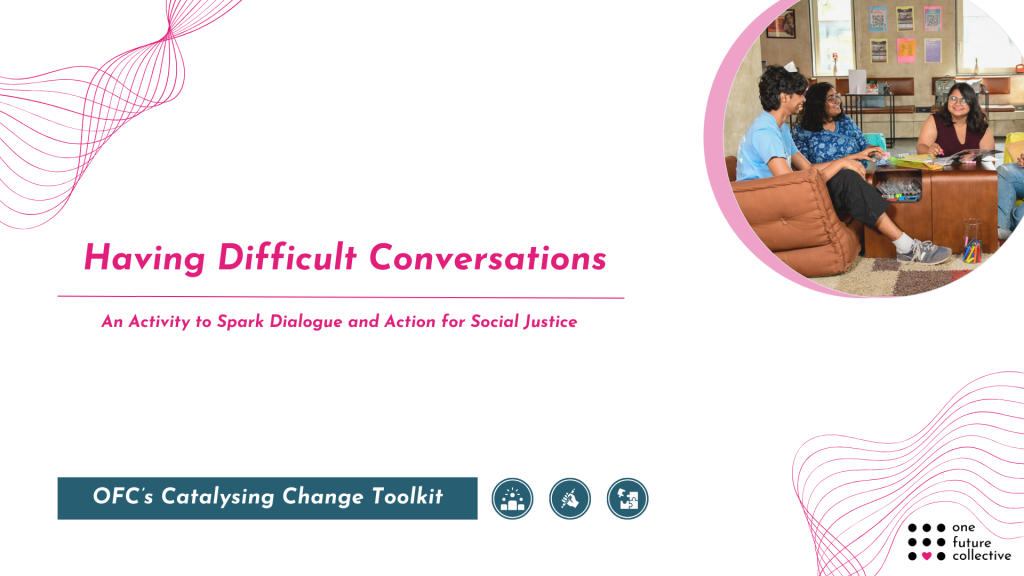
Master the art of navigating tough conversations with confidence and care. Learn strategies for engaging respectfully and effectively on sensitive topics, in this activity!
This activity was made as a part of One Future Collective’s Catalysing Change Toolkit, which includes a variety of facilitation materials, such as activities, reflective exercises, energisers, games, ice-breakers, and more. You can utilise these tools in your communities—be it at your workplace, within your family, or among friends—to bring about meaningful change. Through these resources, you can engage in reflection, foster dialogue, raise awareness, and advocate for important issues.
Remember, change starts with you, today. So let’s dive in!
✨ Why This Matters
Difficult conversations are part of life, yet they can often feel daunting, especially when the topics are sensitive or controversial. Whether it’s discussing political issues, identity, or personal values, these conversations are essential for creating understanding and fostering change. This activity gives you the skills and strategies to approach such conversations with confidence, care, and thoughtfulness. It equips you with practical tools to handle these challenging dialogues in a way that is respectful and productive, ensuring that even the toughest subjects can be addressed constructively.
By learning how to stay grounded and communicate effectively, you’ll be able to address sensitive issues like gender identity, climate change, or political conflicts in a way that promotes understanding rather than division.
In addition to improving your communication skills, this activity also empowers you to approach difficult discussions with empathy and emotional intelligence. It provides you with strategies to listen actively, express your own views clearly, and navigate moments of tension without losing composure. Whether in personal relationships, the workplace, or broader community discussions, these skills are essential for creating environments of mutual respect and understanding.
???? What You’ll Unlock
- Self-identify strategies to engage in conversation about controversial or difficult subjects with different audiences.
???????? Who Can Facilitate
This resource can be used to facilitate skill building in small groups of any size learning about feminist leadership.
???? What You’ll Need
- Pen
- Paper
⏳ Clocking It In
40 minutes
| ???? Step-by-Step Facilitation Guide ???? |
Step 1: Set the Tone (5 minutes) Start by welcoming participants and introducing the activity. Highlight that while difficult conversations are often avoided, they are an essential part of growth, understanding, and change. Let participants know that the goal of this activity is not to “win” conversations, but to engage in them with empathy, respect, and clarity. Encourage an open, non-judgmental environment where everyone’s experiences and perspectives are valued. You can start with a quick icebreaker to get everyone comfortable. Ask participants to share a topic they find difficult to discuss and why; this helps set the stage for the type of conversations you’ll be working through. Step 2: Form Small Groups & Begin the Brainstorming (5 minutes) Split participants into small groups of 3-5 people, ensuring a diversity of perspectives in each group. The smaller group setting allows for deeper, more personal conversations. Distribute the worksheets that guide participants through the steps of preparing for a difficult conversation. Each group will work through these steps and develop responses for each one. Before diving in, explain that the worksheet is not a strict script, but a tool to help them navigate the conversation thoughtfully and with care. Step 3: Start the Conversation: Explore the Topic (10 minutes) In each group, ask participants to choose one difficult topic to focus on. It could be something political, personal, or global- such as the climate crisis, gender identity, or the abolition of prisons. Once the topic is chosen, they should follow the worksheet to plan how to approach the conversation. Encourage them to use the prompts in the worksheet to guide their discussion. Encourage participants to think about their own experiences and how they’ve navigated difficult conversations in the past. What worked? What didn’t? How can they improve? Step 4: Role Play: Practice the Conversation (10 minutes) Now, invite participants to role-play the conversation in their groups. Each person should take turns playing the role of both the speaker and the listener. This gives everyone a chance to practice articulating their own views while also learning how to listen actively and with empathy. Remind participants to use the strategies they’ve brainstormed, like staying calm, using “I” statements, and focusing on understanding the other person’s perspective. During role-play, participants should focus on: ???? Staying grounded and managing any emotional reactions. ???? Asking open-ended questions to encourage the other person to share their viewpoint. ???? Identifying moments when the conversation might not be going well and deciding how to steer it back on track. Step 5: Group Reflection, Share and Debrief (5 minutes) After the role-playing exercise, bring everyone back together for a group discussion. Ask each group to share their experiences. Here are a few key debrief questions to guide the discussion: ???? How did the conversation feel during the role-play? Was it challenging? Why or why not? ???? Did any group members find certain steps especially difficult to implement? Which ones, and why? ???? What strategies worked well in the role play? ???? Were there any moments where you felt the conversation became more productive or respectful? ???? How did you handle moments of tension or disagreement? What did you learn from that? Encourage participants to be open about the difficulties they encountered. It’s important to normalize the discomfort that often accompanies difficult conversations and emphasise that these skills improve with practice. Step 6: Closing (5 minutes) End the session with a final reflection. Ask participants to share one word or phrase that sums up their experience of the activity. Reinforce that difficult conversations are a normal and necessary part of life, and that everyone can improve their ability to navigate them with practice. Remind them that the key to effective communication is not just about having the “right” answers, but about fostering respect, empathy, and understanding. Thank everyone for their participation and encourage them to continue practicing these skills in their everyday lives |
Worksheet for Preparing to Engage in a Difficult Conversation
| Step | What will you say? |
| Spend some private time to identify the problem and acknowledge different points of view. | |
| Be certain this is a problem that is worth addressing. | |
| Invite the other person to talk with you. | |
| Start the conversation by “seeking first to understand.” | |
| Share your own point of view, your intentions, and your feelings. Use “I” statements. Take responsibility for your part. | |
| Talk about the future and what can happen differently so you don’t end up in the same place. | |
| Thank the other person for talking with you. |
If you have any questions, requests, or feedback, write to us at info@onefuturecollective.org.
This resource was created by One Future Collective. Please cite us if you reproduce, circulate, or facilitate this material to honour the labour of our team members and uplift their work accordingly. In the words of Sara Ahmed, ‘Citation is feminist memory.’
Copyright © [2025] by One Future Collective [Morarka Consultants LLP] All Rights Reserved.