

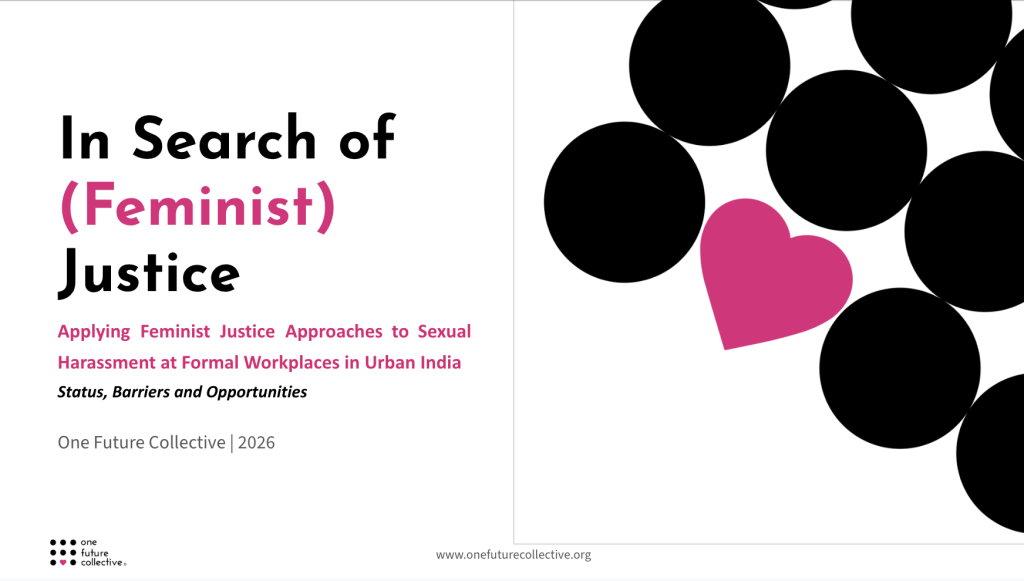
On March 25, we at One Future Collective hosted a virtual convening of 30 researchers, professionals, and activists working on workplace justice to share the findings of a research study exploring the status, barriers, and opportunities in applying feminist justice approaches to sexual harassment at formal workplaces in urban India. We discussed how justice can be reimagined to be more survivor-centric, trauma-informed, and transformative. In this blog, we share key insights from the sharing of findings and subsequent panel discussion at this convening.
About the research study
‘In Search of (Feminist) Justice’ is a research study from One Future Collective, primarily authored by Founder and CEO, Vandita Morarka, co-authored by Anvita Walia and Uttanshi Agarwal, with Manogna Matam as a research associate. This is a feminist, grounded theory-based, qualitative inquiry that uses key informant interviews and design labs with PoSH practitioners across urban India. The central provocation of the study, which was arrived at using both theoretical and empirical evidence of working with survivors and supporting professionals, is that current systems of justice against workplace sexual violence are not feminist. The study allows us to seed a reimagining of practices, measurement systems, and continuing action.
A framework for reimagining justice that emerged from the study is called the ‘Tapestry of Justice’, which conceptualises several threads of work that fluidly merge into each other and push back against ‘neutrality’ as a justice approach. Instead, it centres the lived realities and social structures within which violence occurs.
Vandita’s presentation of research findings was followed by a panel discussion. The objective of the panel was to further understand the status of and emerging intersections in possibilities for justice pathways in cases of sexual violence in urban formal workplaces, feminist or otherwise. You can watch a recording of the panel below, or read on for some key insights.
Meet our panelists
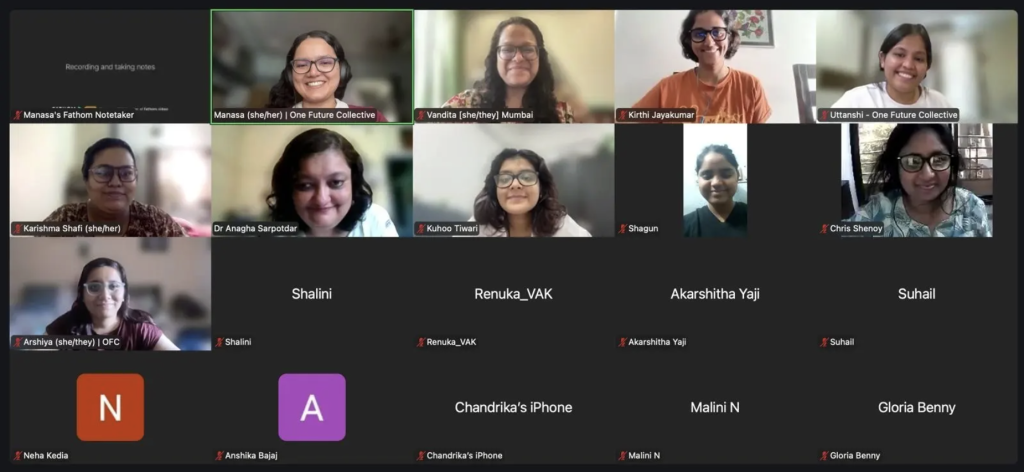
This panel discussion, moderated by Vandita, hosted the following experts.
Dr Anagha Sarpotdar is a researcher–practitioner specialising in workplace sexual harassment, with a PhD from TISS on its social and legal dimensions. She serves as Chairperson of the Mumbai City Local Committee under the PoSH Act.
Kirthi Jayakumar is a researcher at the Inclusive AI Lab and founder of Civitatem Resolutions, working at the intersection of technology, gender, and justice. She created Saahas, a platform supporting survivors of gender-based violence and enabling bystander intervention.
Meghana Srinivas is the Founder and CEO of TrustIn, a legal-tech platform enabling end-to-end PoSH implementation through secure, trauma-sensitive solutions. Her work focuses on strengthening workplace redressal systems and expanding access to justice at scale.
Zainab Patel is a transgender rights leader, DEI strategist, and social entrepreneur advancing inclusion across corporate India and grassroots communities. Through initiatives like The Trans Café and Pride Business Network Foundation, she creates pathways for dignity, livelihoods, and visibility.
From the panel discussion
This was a panel of experts from a range of fields, all allied to the work of supporting survivors of sexual and gender-based violence, at and outside of work. Read on for the key insights generated from this powerful conversation.
Implementation gaps: why do they exist and who do they impact?
The panel extensively discussed the current status of PoSH law and the response to workplace sexual harassment in urban India. In particular, they celebrated the legislative framework for being forward-thinking and focused on civil law, with Meghana lauding its focus on rehabilitative support. Dr Anagha discussed its history and noted that in practice, it presents a complex and unclear appeals process that is difficult for survivors to access and understand. Kirthi was also less optimistic about the law, identifying it as a colonial tool for organisational compliance that acts to maintain the status quo. Zainab also noted that the law, although hard-earned, is regularly negotiated and diluted in the real world and buried under bureaucratic hierarchies and compliance work. Dr Anagha identified a similar issue, criticising the corporatisation of PoSH work, which is at once structured and mechanical and haphazard, in that anyone can be ‘certified’ to be an external member by any agency, even if its authority to award such certification is unverified. The outcome, both she and Meghana warned, is external members handling cases with little understanding of their role as unbiased watchdogs, or their history.
In fact, organisational focus on compliance emerged as an important factor that hindered effective justice practice. Many organisations, both Kirthi and Vandita observed, are more preoccupied with compliance than with the delivery of justice to survivors. In Zainab’s words, this leads to Internal Committees (ICs) that are “technically compliant but socio-culturally compromised”.
Zainab drew from her experience in Diversity, Equity and Inclusion (DEI) work across several industries to highlight some harmful practices that define such compliance. Among them, she mentioned tokenism, optics-oriented language and complaint management systems that create paper trails to protect employers but do not lead to any form of transformative power-shifting, calling PoSH an exercise in ‘risk calculation’. As well, she identified how many workplaces push women to choose informal resolution rather than the complete process available to them.
Such bad faith practices, discussed by Zainab and Dr Anagha, lead to weak implementation of the PoSH law as a structural rather than accidental outcome that weakens the power of civil law and prevention work. Hardest hit, they note, are domestic, gig, and contractual workers, queer-trans workers, young employees, and women lacking the resources, support, and career opportunities to challenge the unchecked ‘god-like’ authority of ICs and pursue long and resource-intensive criminal procedures. “If you are not a cis, full-time, English-speaking employee in an office, you stand outside the doors of the justice system”, noted Zainab. Meghana, too, highlighted evidence that shows that many people do not return to full-time employment after negative experiences of this type, meaning PoSH practices have deep ramifications for inclusion in the world of work.
In their reflections on strategies to solve these wide implementation challenges for justice pathways against sexual harassment at work, the panellists spoke about systems of community and care, as well as the opportunities presented by technology.
Technological (im)possibilities against sexual violence at work
Kirthi, who has developed Saahas, an app for bystander intervention for survivors of sexual and gender-based violence, and Meghana, who works at the intersection of technology and PoSH, brought several key insights to the conversation on technosolutions for sexual violence at work.
Kirthi shared that Saahas was developed in response to their own need for help, as well as that of others, in cases where it is crucial to speak up against violence without access to power and the apparatus to seek justice. They underlined the importance of not extracting user behaviour data while developing and deploying Saahas, such as by using a rules-based chatbot and prioritising full user confidentiality.
Crucially, Kirthi cautioned the room to continue to reflect on and challenge the definitions and accountability standards of their ‘feminisms’ and the care infrastructure they build. They also hesitated to claim that technology was without fault and could solve all the challenges presented by sexual violence at work.
Meghana agreed, noting that, “When you automate inefficient systems, you amplify their inefficiencies.”
In particular, the inefficiencies Meghana was referring to were those of human bias, a less intersectional perspective, and unresolved power differentials in the workplace. To illustrate how unacknowledged power imbalances can shape workplaces, they used the example of the purported ‘caste-blindness’ of many employers, which leads to unequal relationships at work. They further established that these differences also shape the language people use, which in turn shapes their understanding of harm, agency, and the experience of power itself. Given that different teams use different languages, any tools they use are only as good as their articulation of the issue and the contexts in which they operate.
Speaking of artificial intelligence or AI, Meghana noted that it can be a useful resource for tasks like language translation and pattern recognition in types of harm and appropriate responses, therefore easing the burden on ICs, which are often not sufficiently trauma-informed and also prone to vicarious trauma themselves. Yet, they warned that internal or confidential employee data is best kept safe against AI scraping by storing it on internal servers. Crucially, in a sentiment that was echoed across the panel, they asserted that although the justice process can be automated in some ways, people’s experiences cannot, and must be understood in their complete complexity.
Strategic opportunities: ‘Centring humanity in design’
To conclude the discussion, Vandita invited ideas for strategic action that can help bridge the gaps that were articulated in policy and practice through the discussion. Some of the ideas that were brought in were:
- Transforming and expanding legal systems by developing care-based grievance redressal mechanisms for trans and queer employees and other gender minorities.
- Embedding relational and financial care within the civil law mechanism to ease congestion on the criminal law system while meaningfully holding survivors in their specific contexts.
- Developing a central body that can train IC members to be more trauma-informed, survivor-centric, and legally informed.
- Naming sexual harassment beyond its prevention as a form of harm that has deep consequences for survivors. This involves, for example, replacing the term ‘PoSH case’ with ‘sexual harassment case’.
- Moving from compliance to community in the form of community governance models of justice. These may not be ‘technically compliant’, but can serve as a creative exercise in effective stewardship of the process of justice.
Ultimately, this closed-door convening invited professionals, researchers, and activists working in the arena of workplace justice to discuss the evidence and align on many crucial avenues of action towards creating safer workplaces.
Our research study, ‘In Search of (Feminist) Justice,’ will be released in June 2026. We look forward to sharing it with you. Follow One Future Collective on LinkedIn, Instagram, and Substackto stay updated and find more resources until then.